Aaron Sorkin’s The Social Reckoning opened in theaters on October 9, with Mikey Madison as Facebook whistleblower Frances Haugen, Jeremy Allen White as Wall Street Journal reporter Jeff Horwitz, and Jeremy Strong as Mark Zuckerberg. The film ends with Haugen’s Senate testimony in October 2021.
The real story did not end there. The internal research Haugen carried out of the company has spent the five years since moving from newspaper pages into congressional hearings, state investigations, and finally courtrooms, where juries in 2026 have started returning verdicts against Meta.
Who Frances Haugen Is
Haugen is a data engineer and product manager who joined Facebook in 2019 and worked in its civic integrity unit, the group that dealt with misinformation and other harms around elections. Before she resigned in May 2021, she copied tens of thousands of pages of internal documents.
She shared them with the Wall Street Journal, which began publishing its series “The Facebook Files” in September 2021, and with members of Congress. She also filed complaints with the Securities and Exchange Commission alleging that the company’s own research showed problems it was not disclosing to the public or investors. Facebook later said she had not worked on child safety or Instagram and lacked direct knowledge of those subjects.
What the Documents Showed About Teenagers
The disclosures covered a wide range of subjects, including political misinformation, a program that exempted high-profile users from some moderation rules, and the use of the platform by drug cartels and human traffickers. The part that drew the most public attention concerned Instagram and teenage girls.
According to the internal research Haugen disclosed, a 2019 Facebook presentation concluded that Instagram made body image issues worse for one in three teen girls. A 2020 study found that 32 percent of teen girls said Instagram made them feel worse when they already felt bad about their bodies. Another internal study reported that 13.5 percent of teen girls said Instagram made thoughts of suicide worse, and 17 percent said it made eating disorders worse.
Facebook’s public position was that the reporting mischaracterized its research, which the company described as an effort to understand and address difficult issues.
Going Public and Testifying
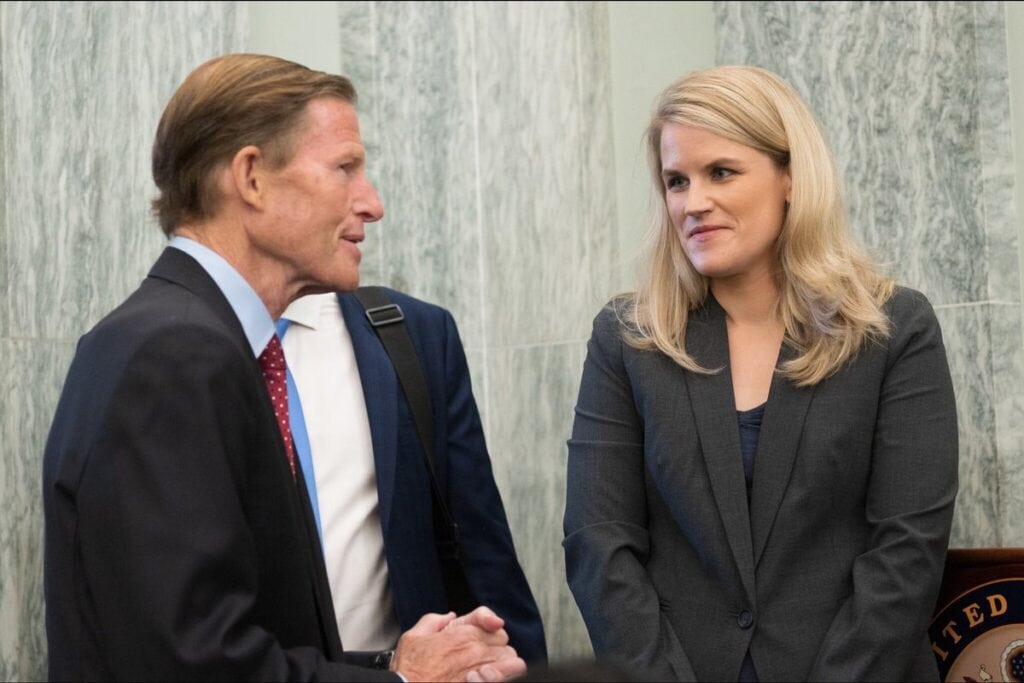
Haugen revealed her identity in a 60 Minutes interview on October 3, 2021. Two days later she testified before the Senate Commerce Subcommittee on Consumer Protection, Product Safety, and Data Security, chaired by Senator Richard Blumenthal. She told senators that the company knew how to make Facebook and Instagram safer but would not make the changes because they conflicted with growth and profit, and she urged Congress to regulate social media the way it regulates tobacco, automobiles, and opioids.
The effects came quickly. Instagram had already paused its planned “Instagram Kids” app in late September 2021, after the first Journal stories. In November 2021, a bipartisan group of state attorneys general announced an investigation into how Meta attracted and kept young users. Instagram head Adam Mosseri was called before the same Senate subcommittee that December.
From Disclosures to Lawsuits
The documents gave plaintiffs’ lawyers something product liability cases depend on: evidence of what a company knew and when. Lawsuits filed on behalf of young people and their families began citing the research, and in October 2022 the federal cases were consolidated in the Northern District of California as MDL No. 3047, In re: Social Media Adolescent Addiction/Personal Injury Products Liability Litigation, before Judge Yvonne Gonzalez Rogers. A parallel proceeding in California state court, JCCP No. 5255, is overseen by Judge Carolyn B. Kuhl in Los Angeles. In October 2023, dozens of states sued Meta, building in part on the investigation opened after Haugen’s disclosures.
The lawsuits allege that Instagram, Facebook, TikTok, Snapchat, and YouTube were designed to keep young users engaged through features such as algorithmic feeds, infinite scroll, autoplay, and constant notifications, and that the companies knew from their own research that heavy use was harming some minors but did not warn families. Courts have allowed design-based claims to proceed past the platforms’ Section 230 and First Amendment defenses, while limiting some claims tied to content posted by other users.
2026: The Documents Reach a Jury
The first California personal injury trial, brought by a young woman identified as K.G.M., opened in Los Angeles in February. Her lawyer, Mark Lanier, showed jurors internal Meta and YouTube material, including a 2015 email from Zuckerberg calling for a 12 percent increase in time spent on Meta’s platforms. Testimony also covered Project MYST, an internal Meta study conducted with the University of Chicago, which found that parental supervision and time limits had little association with whether teens could control their social media use, and that teens facing more adverse life experiences were less able to regulate it. Mosseri testified that the findings were never published and that no warnings resulted from them.
In March, the jury found Meta and YouTube liable and awarded $6 million, including $3 million in punitive damages. Both companies are appealing. The same month, a New Mexico jury returned a $375 million verdict against Meta in the state’s child safety case, and in August the court added $567 million more. Also in August, Meta reached a settlement with 51 attorneys general valued at up to $17.1 billion, an agreement that creates no claims process for families and preserves individual injury claims.
More than 3,800 cases are now pending in the federal MDL, with roughly 3,000 more in the California state proceeding. The next California trial, against Meta and Snap, is scheduled to begin in Los Angeles on October 28.
The Film and the Record
The Social Reckoning is a dramatization that condenses and reshapes events for the screen. The documents behind it are not fiction. They remain part of the public record through the Journal‘s reporting, the congressional record, and now trial evidence, and they continue to shape the cases that thousands of families are pursuing.
Who Is Bringing These Claims
The individual cases commonly involve a young person who used social media heavily, often for hours a day, beginning in childhood or the teenage years, and who was later diagnosed and treated for a condition such as an eating disorder, depression or severe anxiety, body dysmorphia, self-harm, or suicidal thoughts. Families who lost a young person are also bringing claims. Many claimants are now in their late teens or twenties and can pursue a claim on their own. Filing deadlines vary by state.
Doyle APC represents individuals with social media addiction claims. More information is on the firm’s social media addiction lawsuits page.
See If You Qualify
Doyle APC handles social media addiction cases together with experienced co-counsel. There is no cost to find out whether you qualify, and clients pay no fees or costs unless there is a recovery.
"*" indicates required fields
If you or someone you know is struggling with thoughts of suicide or self-harm, the 988 Suicide and Crisis Lifeline is available 24 hours a day by calling or texting 988.